September 6, 2011

Providing for Soldiers' Families

A soldier's family in camp, allegedly with the 2nd Pennsylvania Reserves.
Library of Congress, LC-USZC4-7983


In reading wartime newspapers and soldiers' letters to their wives, something that has stood out to me is the very precarious existence that many poor and working class soldiers' families often faced.  It appears that many soldiers' going off to war put their families at risk not just financially, but also in terms of basic physical needs (e.g., food, medical care, fuel for winter).  I don't know how soldiers' army pay compared to that of their prewar occupation, but delays in receiving pay and logistical barriers to sending pay home certainly made things difficult.

Although newspapers record a couple tragic stories of 79th Pennsylvania families, most soldiers' families seem to have coped with the war's difficulties through some combination of:
  1. Remote support from the soldiers themselves through letters.  As well as basic emotional support, the letters often contained specific directions for managing finances, procuring necessary goods, and even raising children.  The Lewis H. Jones letters at the Lancaster County Historical Society are fantastic in this regard.  A working class father of several young children with another one on the way, Jones was one of several men from South Queen St. who joined Co. H, 79th Pennsylvania, while the regiment was being recruited.  Besides expressions of devotion, his letters to his wife Elizabeth give instructions for which bills to pay and with which priority, tell her at which stores to get goods and the status of their account there, and give words of support to pass on to children to encourage their good behavior: "Tell josey to be a good boy and go to school." (11/6/1861)  "Tell Washey and Josey that they must not go to the crik [presumably, Conestoga Creek] or I wont give them eney money to buy cakes and ice cream" (6/29/1862)
  2. Support from informal familial and social networks.  Lewis Jones' letters reveal a somewhat strong network among the South Queen Street families and their soldiers in the 79th Pennsylvania.  When Jones' friend and wife's brother-in-law died of disease in early 1862, Joseph also tried to help the Maxwell family in many ways, including one note from an 6/25/1862 letter, "Give Josephine [Maxwell] a dollar to buy som things for her childern for the forth of July."  The city's professional class also occasionally worked pro bono on behalf of needy soldiers' families, and one doctor's alleged indifference toward the Maxwells became part of a libelous campaign against the doctor when he ran for mayor in 1862 (another story for a couple months down the road).     
  3. Support from institutions, private and public.  Religiously-oriented aid groups, such as the Union Dorcas Society, had already existed in Lancaster before the war and easily extended their mission to meet the needs of soldiers' families.  The Mennonites, whose wealth (as a group) and pacifism sometimes made them targets of scorn among the war's supporters, appear to have contributed prominently to aid efforts for soldiers' families.  Finally, as the article below indicates, the Lancaster County Commissioners also arranged for public sources of aid for soldiers' families, but I don't know too much about how public aid worked, so I'll be likely to revisit this topic as I learn more about it in the future. 
From the August 27, 1861, Daily Evening Express: (alternate link), it's apparent that some soldiers' families faced hardships even before the regiment left Lancaster.  Read on further in the column for an appeal (with some humor) to ladies to knit stockings for soldiers. 

September 5, 2011

Recruiting Update

"Recruiting in New York, August 1861" Harper's Weekly September 7, 1861
It's been a couple weeks since my last update on recruiting for Colonel Hambright's regiment, so let's go back a little to an update that appeared in the August 26, 1861, Daily Evening Express. (alternate link) For those unfamiliar with how Civil War armies were structured, a regiment was the basic unit of operation on the battlefield with an ideal strength of 1,000 men. It was comprised of ten companies with 100 men each. Companies were the basic unit of recruiting, and men from each company tended to be from the same hometown or from two or three villages.


And from the August 27, 1861, Daily Evening Express: (alternate link)


Here are some company-by-company notes about the regiment:
  • As mentioned in the article, Captain Kendrick's company was filled largely with men from the Jackson Rifles.  More on Captain Kendrick in the future and his company, which became Company A.
  • Capt. Seaver never went off to war, but his company of German-speaking men going off to fight under Lieut. Klein as Company F.  According to the article, both of the officers fought in the failed Revolution of 1848 under later Union General Franz Sigel.  Seeing the company described as the "German Sharpshooters," I wonder if they had any connection to popular German shooting clubs of the 1850s and 1860s that occasionally were mentioned in newspapers. 
  • The company mentioned being recruited by Capt. Haines might have ended up going off to war with the 45th Pennsylvania led by Col. Thomas Welsh of Columbia. 
  • Lieut. Michael Locher, operator of a billiard saloon on Centre Square, ended up leading Company H.
  • Capt. Duchman's company later became Company B.
  • The other companies mentioned did not end up joining the 79th Pennsylvania, and that's another story for another time, probably related to the article's last couple paragraphs about the chaotic process of organizing companies and assigning them to regiments.
So, as of August 27, we're looking at the origins of four of the companies of what would become the 79th Pennsylvania being accounted for.  More updates to come.

See also:
It's Official: Raise a Regiment

September 4, 2011

The Situation in Kentucky Deteriorates

Presentation of a flag to Kentucky Volunteers, September 1861
Harper's Weekly October 5, 1861

Today marks an important anniversary in which the national narrative and the story of the 79th Pennsylvania converge to help explain why the regiment fought in the war's Western Theater (i.e., Kentucky, Tennessee, Missouri, etc.).  On September 3-4, 1861, Confederate forces under Gen. Gideon Pillow marched into the state to seize a strategic position along the Mississippi River, violating its stated position of neutrality.  Until then Kentucky was walking a delicate balance of a pro-Southern governor, an official position of neutrality, a populace sympathizing more and more with the Union, and Northern and Southern armies camped on its doorstep. 

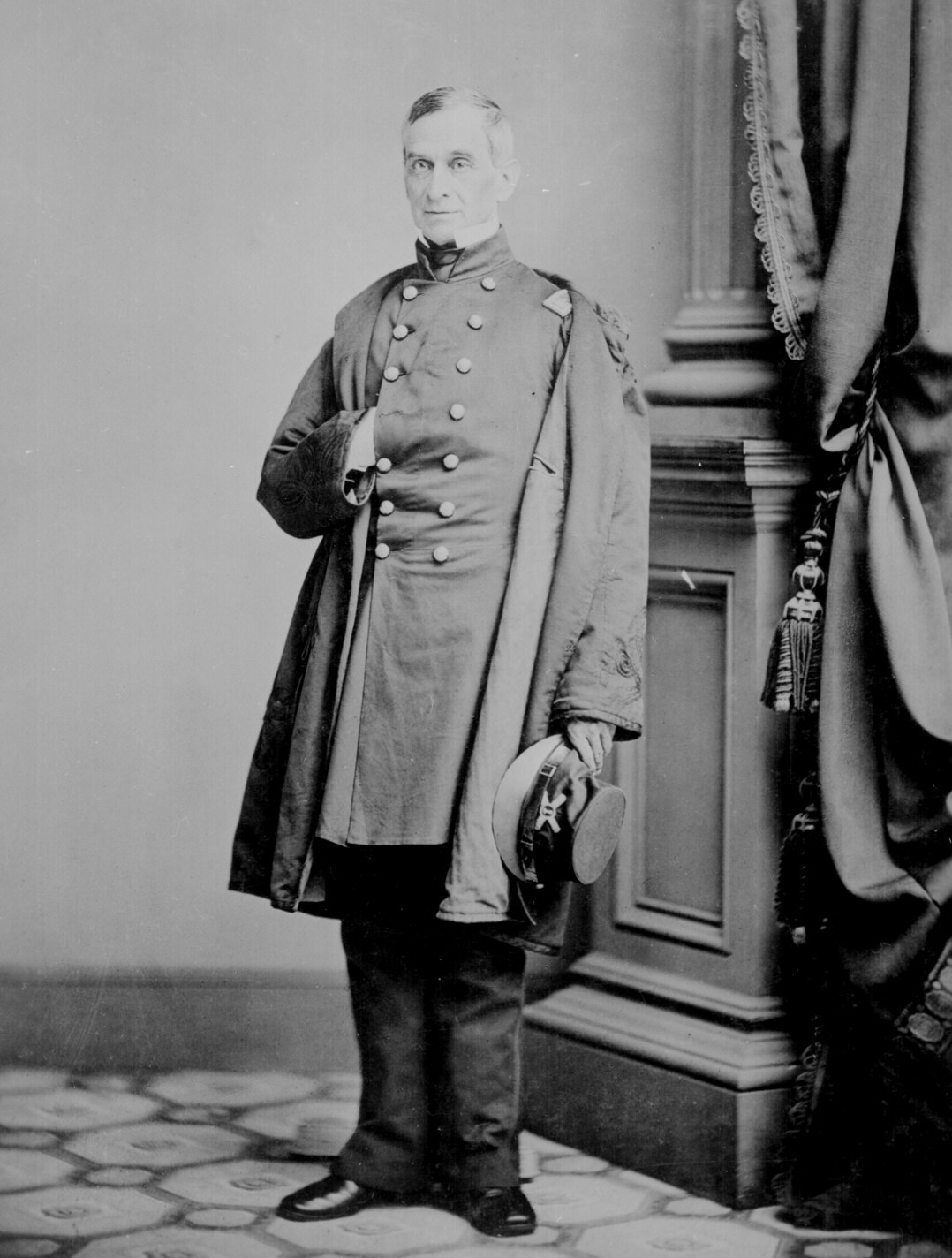
In response to Pillow's invasion, Union forces under Brig. Gen. Ulysses S. Grant entered Kentucky a couple days later.  Kentucky's governor wanted everyone out, but the General Assembly basically sided with the Union, setting the stage for a shadow Confederate government.  Overall command of Union forces in the region (the Department of the Cumberland) rested with Brig. Gen. Robert Anderson (hero of Fort Sumter) and later with Brig. Gen. William T. Sherman, both of whom seemed overwhelmed by the task before them.  Their pleas for more soldiers presumably influenced the War Department to route the 79th Pennsylvania and a couple other Pennsylvania regiments to Kentucky.

Read more:
Kentucky in the Civil War Wikipedia page
The Civil War in Kentucky: Battle for the Bluegrass State by Kent Masterson Brown

Brig. Gen. Robert Anderson, initial commander of the Department of the Cumberland
By Mathew Brady [Public domain], via Wikimedia Commons

September 2, 2011

An Introduction to Civil War Newspaper Quarrelling

For better or for worse, much of what we know about wartime beliefs and attitudes comes from bickering, mostly of a partisan political nature, between the various editors of Lancaster's newspapers.  We infer that sometimes people would just roll their eyes when Editor X got his feathers ruffled over something Editor Y said, and I even recently read a soldier's letter published in the Lancaster Daily Inquirer that said to one of the editors not to take the controversies so seriously as Lancaster's reading population basically didn't.

However, sometimes these squabbles really did have significance as they outline the topography of opinions on questions such as: How does one oppose the war without being a traitor?  What was the real purpose of the war?  How does slavery tie into that purpose?  Who was and wasn't pulling their weight when it came to fighting the war?

Vigilance Committee of Memphis accosts Harper's Weekly sketch artist (Harper's Weekly June 22, 1861)

So, as a case study, let's look at a row from August 1861 centered around the unique and interesting character of Josiah Rhinehart Sypher (b. 1832), a man whose wartime occupation could (honestly) best be described as a "gentleman adventurer."  Though independently wealthy, Sypher was trained as a lawyer under Thaddeus Stevens and spent the war mostly traveling with the armies, primarily with the Army of the Potomac, but also occasionally in the West where his brother commanded a section of an artillery battery that actually once went on an expedition with the 79th Pennsylvania.

During occasional stops to Lancaster, Sypher agitated for certain political and social causes, like education reform, the temperance movement, and a pro-Republican agenda for prosecuting the Civil War.  As the war drew to a close in 1865, Sypher published one of the first Civil War unit histories ever written, History of the Pennsylvania Reserve Corps--a division of Pennsylvanians that fought with the Army of the Potomac--and later wrote other history and education books.  Sypher's correspondence while following the Army of the Potomac also found their way to the pages of the New York Tribune, qualifying him as some sort of war journalist. 

At the war's outbreak, Sypher apparently was either visiting or living in Memphis, Tennessee.  He returned to Lancaster in late June or early July, and published an account in the July 5, 1861, Daily Evening Express: (alternate link)


In mid-August 1861 (maybe 8/11 or 8/12), Democrats held a rally at Drumore Centre, a crossroads in southern Lancaster County.  The Democratic press portrayed them as hardworking laborers now prepared to fight the war that abolitionists had started but were too afraid to fight, and the Republicans portrayed them as traitors who hailed the Confederate victory at First Bull Run.

Anyway, J. R. Sypher showed up and caused a commotion, and later wrote to the Lancaster Union (newspaper did not survive, as far as I know) accusing the whole convention as being orchestrated by the Intelligencer.  The Intelligencer retorted on August 20: (alternate link)


On August 20, the Daily Evening Express jumped in the fray, coming to the defense of J.R. Sypher and attacking Mayor Sanderson (who also published the Intelligencer): (alternate link)


Four days later, on August 24, Sypher replied in his own words: (alternate link)


Mayor Sanderson's next issue on August 27 did not address the issue specifically, so I'll stop here.  There is plenty of good material though from the August 1861 Intelligencer editions (available to browse here) in which the Democratic Party claims an identity as a party of "Peace, Law, and Order" (8/27) and the party that would actually be supplying the soldiers who comprised the Union army. 

As the 79th Pennsylvania goes to war, expect the newspapers editors in Lancaster to find many more trivial and substantial issues over which to quarrel, many of which related directly to the regiment. Soldiers' diaries and letters show that they definitely paid attention to what was going on in Lancaster, and we also know that there was a constant flow of newspapers from printing presses on S. Queen St. to camps in Kentucky and Tennessee.